


For years, hiring professionals have focused on solving a familiar problem: how to identify qualified candidates efficiently within an increasingly competitive labor market. The emergence of artificial intelligence promised to make that challenge easier. AI-powered sourcing tools, resume screening platforms, interview preparation assistants, and candidate matching technologies were expected to streamline hiring and improve outcomes for both employers and job seekers.
In many ways, they have.
Candidates today have access to unprecedented resources that help them build stronger resumes, prepare for interviews, research companies, and present themselves more effectively. Employers can process larger applicant volumes, identify relevant skills faster, and automate administrative tasks that once consumed valuable recruiting hours.
Yet as AI adoption accelerates across the hiring landscape, an unexpected challenge has emerged.
While AI has undoubtedly improved efficiency, it has also made it increasingly difficult to distinguish genuine capability from optimized presentation.
The hiring process has entered a new phase..one where nearly every candidate can appear highly qualified, highly prepared, and highly aligned with a position. The question facing organizations is no longer how to find applicants. The question is how to identify the right applicants.
One of the most significant shifts created by generative AI is the transformation of the traditional resume.
Historically, resumes served as a reflection of a candidate's experience, communication skills, and ability to articulate accomplishments. Strong candidates often distinguished themselves through the quality of their storytelling, clarity of achievements, and understanding of the role they were pursuing.
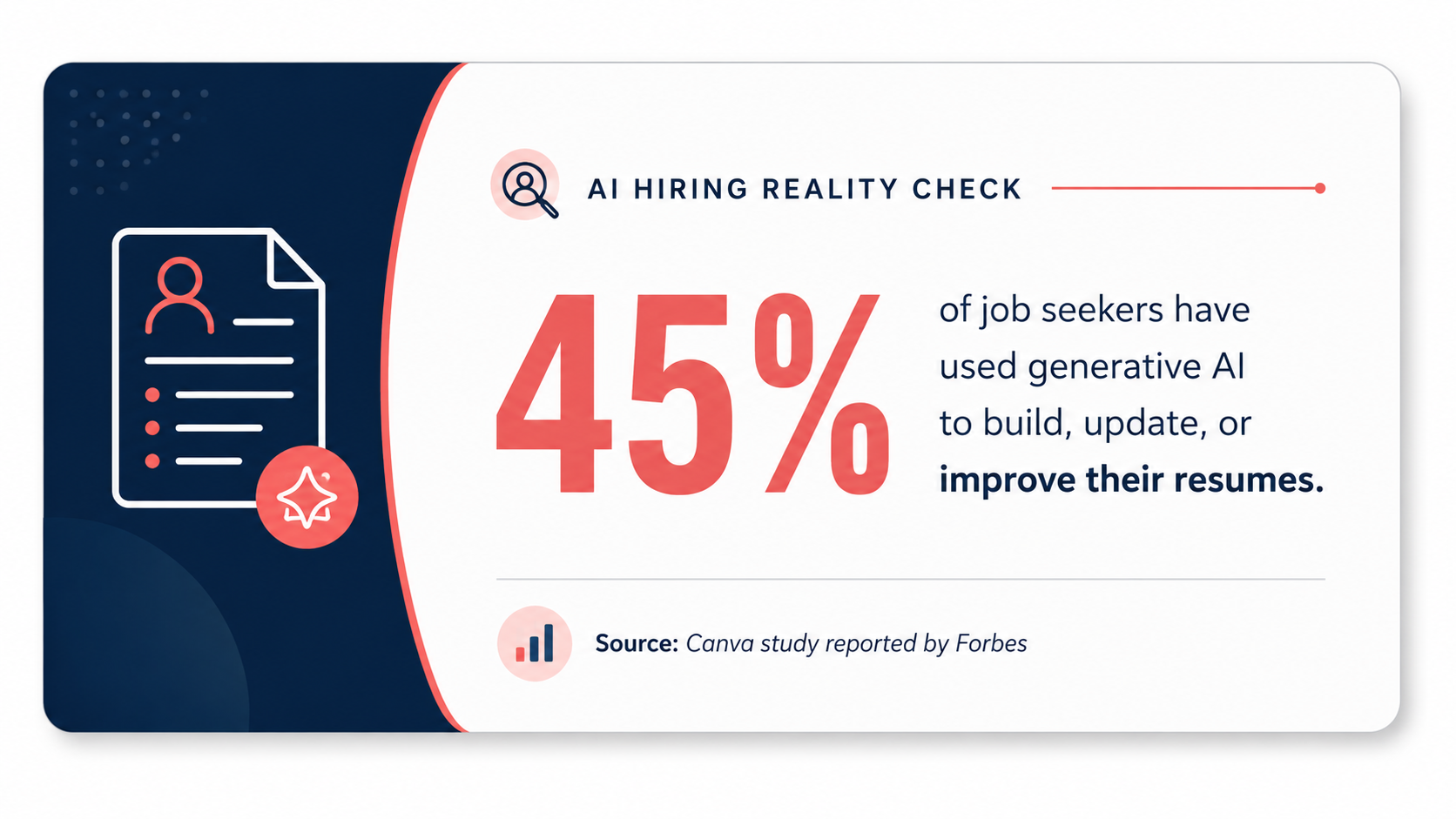
Today, AI tools can generate highly polished resumes within minutes. Job seekers can paste a job description into an AI assistant and receive tailored resume recommendations, optimized bullet points, industry-specific terminology, and ATS-friendly language almost instantly.
The result is a marketplace filled with resumes that are technically stronger but increasingly similar.
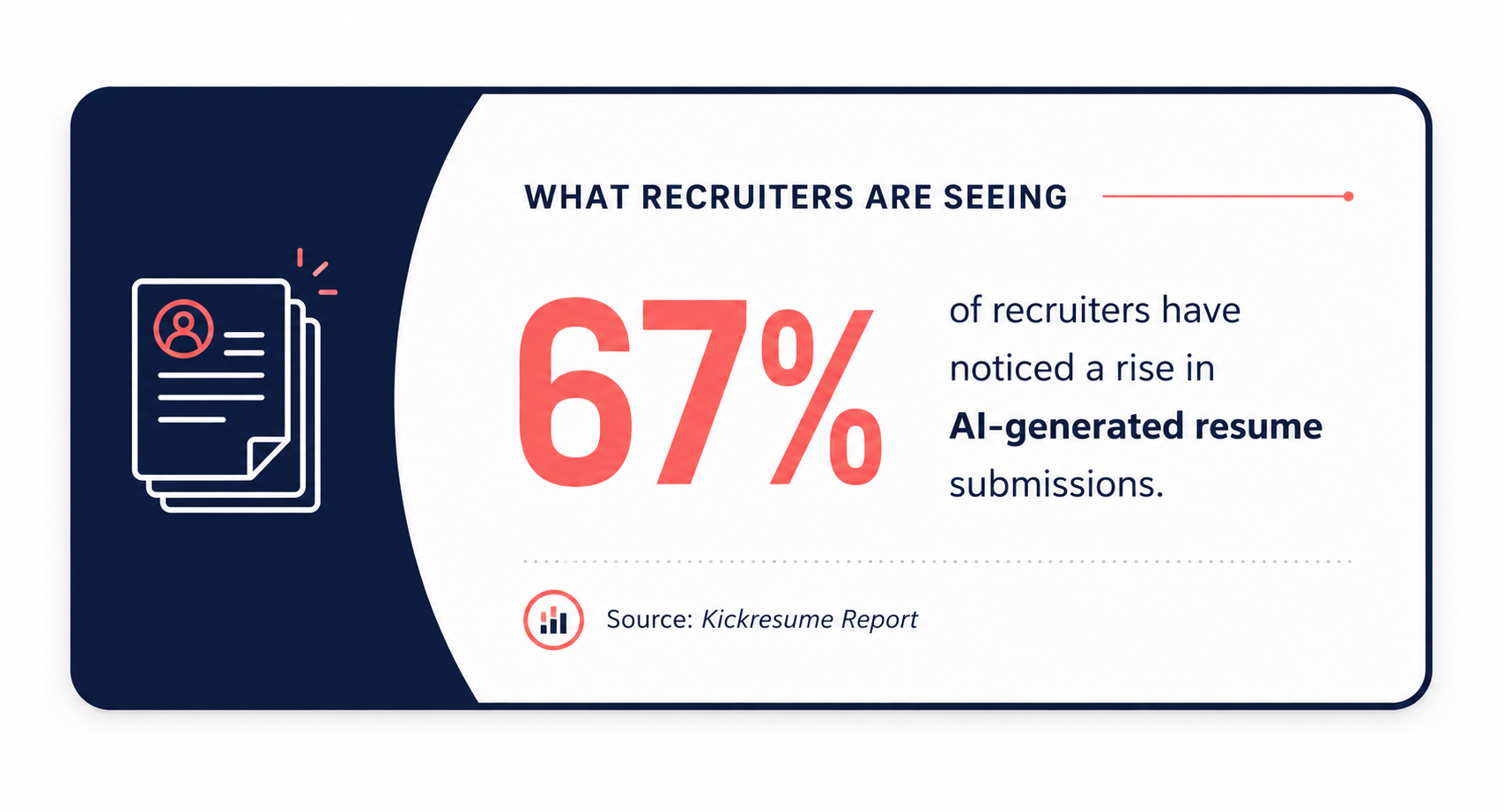
Recruiters across industries are reporting a common experience: reviewing dozens of applications that appear nearly identical in structure, language, and positioning. Keywords align perfectly with job descriptions. Accomplishments are framed effectively. Skills are highlighted appropriately. On paper, many candidates look exceptional.
The challenge is that resumes are becoming better indicators of a candidate's ability to use AI than their ability to perform the actual job.
As a result, hiring teams must invest more effort into identifying the experiences, decisions, and accomplishments that genuinely differentiate one candidate from another.
The impact of AI extends far beyond resumes.
Interview preparation has been fundamentally transformed.
Candidates can now simulate interviews, practice behavioral responses, receive feedback on communication style, and anticipate role-specific questions before ever speaking with a recruiter. For many job seekers, this represents a positive development. Individuals who may not have access to mentors, coaches, or extensive professional networks can now prepare at a level that was previously unavailable to them.
This democratization of preparation has raised the overall quality of candidate interactions.
Candidates arrive more informed. They understand company backgrounds. They communicate more confidently. They are better equipped to discuss their experiences.
From an employer's perspective, these improvements should be welcomed.
However, greater preparation has also introduced new challenges.
When every candidate has access to similar preparation tools, interviews become less effective at revealing natural differences in communication style, critical thinking, and problem-solving ability. Responses become more polished, more rehearsed, and in many cases, remarkably similar.
The traditional interview begins to lose some of its diagnostic value.
A more complex issue emerges when AI moves from preparation into participation.
Reports of candidates using AI assistance during live interviews have become increasingly common. Real-time prompts, AI-generated responses, hidden assistance tools, and secondary screens are introducing entirely new variables into the evaluation process.
This raises an important question.
What exactly are employers evaluating?
The purpose of an interview has never been to test whether a candidate can produce the "correct" answer. Employers are attempting to understand how an individual approaches ambiguity, solves problems, communicates ideas, manages pressure, and exercises judgment.
These qualities are difficult to measure through resumes alone.
When AI begins influencing live responses, employers may gain less visibility into the candidate's actual thought process. A polished answer may no longer indicate genuine understanding.
The concern is not that candidates are using technology. Technology has always influenced hiring. The concern is that hiring managers may inadvertently evaluate AI-generated performance rather than human capability.
The reality is that AI is exposing weaknesses that have existed within hiring processes for years.
Many organizations continue to rely heavily on predictable behavioral questions, resume reviews, and conversational interviews. These approaches were already imperfect measures of future performance. AI has simply amplified their limitations.
Forward-thinking organizations are responding by redesigning their evaluation methods.
Rather than focusing exclusively on what candidates say, they are paying closer attention to how candidates think.
This includes practical exercises, case studies, collaborative problem-solving discussions, work simulations, and deeper follow-up questioning designed to uncover reasoning rather than rehearsed responses.
The objective is not to eliminate AI from hiring.
The objective is to create assessments that evaluate capabilities AI cannot easily replicate.
Ironically, the widespread use of AI may increase the value of uniquely human qualities.
When technology enables everyone to produce stronger resumes and more polished answers, authenticity becomes increasingly important.
Employers are paying closer attention to indicators such as judgment, curiosity, adaptability, emotional intelligence, self-awareness, and genuine expertise developed through real-world experience.
These attributes are difficult to automate because they emerge through lived experiences rather than generated content.
The candidates who stand out are often not those who sound the most polished. They are the ones who demonstrate clear thinking, authentic perspectives, and the ability to connect past experiences to real business outcomes.
AI is not going away. Nor should it.
It has improved efficiency, expanded access to opportunity, and enhanced preparation for both candidates and employers.
However, the organizations that achieve the best hiring outcomes will be those that recognize an important truth: technology can accelerate hiring, but it cannot replace human judgment.
The future of hiring is unlikely to be defined by organizations that resist AI. Instead, it will be shaped by organizations that understand how to use AI effectively while preserving the human elements that determine long-term success.
As AI continues to make candidates look increasingly similar on paper, the competitive advantage will belong to employers who can identify what remains uniquely human.
In the age of artificial intelligence, authenticity may become the most valuable qualification of all.

Where we are