


Hiring has become one of the most important business priorities for growing organizations, yet many companies are taking longer than ever to complete it. Across industries, average hiring timelines for many professional roles now range between 30 and 45 days, while specialized or leadership positions can take much longer. At the same time, several hiring studies indicate that strong candidates are often off the market within 7 to 10 days.
This creates a clear mismatch between how fast the talent market is moving and how slowly many internal hiring systems still operate. While companies are still scheduling interviews, collecting feedback, aligning stakeholders, and discussing approvals, candidates are already progressing through faster-moving opportunities elsewhere.
That delay carries a real cost. Vacant roles reduce productivity, stretch existing teams, slow project delivery, and in many cases lead to missed revenue opportunities. More importantly, delays often result in losing the exact talent the business wanted to hire.
That is exactly why hiring speed deserves more attention than it usually gets. What was once viewed as a recruitment efficiency metric now has a direct impact on business outcomes. When companies are able to hire faster, they are often able to protect productivity, maintain delivery momentum, and secure stronger talent before competitors do. In many cases, that makes time-to-hire less of an internal hiring measure and more of a genuine competitive advantage.
Long hiring cycles are rarely caused by one major issue. In most cases, they are the result of several smaller delays spread across the process. Each delay may seem manageable in isolation, but together they can add weeks to the hiring timeline and significantly reduce hiring effectiveness.
Too many interview rounds: One of the most common reasons for delay is the expansion of interview stages. Roles that once required two or three focused discussions now often involve four, five, or even six rounds. Every additional stage creates scheduling complexity, slows decision-making, and increases the chances of candidate fatigue or drop-off.
Too many decision-makers involved: As more stakeholders enter the hiring process, alignment becomes slower. Instead of moving forward after a strong interview, companies often wait for multiple opinions, approvals, or consensus discussions. What appears collaborative on the surface can often become a bottleneck.
Delayed final decisions: Many organizations continue reviewing profiles even after identifying strong candidates. In trying to secure the perfect hire, they delay action on a very capable available candidate. By the time the internal team is ready, the candidate may no longer be.
Misalignment between hiring teams: Recruiters, hiring managers, and business leaders are not always aligned on urgency, compensation range, or what a strong candidate actually looks like. This often leads to revised shortlists, repeated screening, and confusion during later stages.
Offer and negotiation delays: Even after a preferred candidate is selected, compensation approvals, internal sign-offs, budget checks, and counteroffers can slow closure. This is one of the most sensitive stages because candidates are usually closest to making a decision.
Higher application volume: Many roles now attract more applicants than before. However, higher volume does not automatically mean higher quality. Recruiters often spend more time filtering noise and screening unsuitable profiles before identifying the right shortlist.
That is how hiring slows down in practice. It is rarely one major breakdown. It is usually the accumulation of several smaller delays across the full hiring cycle.
A few years ago, slower hiring was more manageable because the market itself moved at a slower pace. Candidates had fewer visible opportunities, fewer sourcing channels, and less real-time access to new openings. A process lasting six to eight weeks was not unusual, and many candidates were willing to wait through longer timelines.
Today, that environment has changed completely.
Candidates now explore multiple opportunities at the same time. They receive outreach through job boards, professional networks, staffing partners, referrals, and direct employer branding channels. Strong candidates often move through several interview processes simultaneously and make decisions much faster than before.
Expectations have also evolved. Candidates now value responsiveness, clarity, and speed. Long silences, unclear next steps, or repeated delays are often interpreted as signs of poor internal decision-making or lack of seriousness.
That means the market has changed faster than many internal hiring systems. Processes that once felt reasonable now feel slow because candidate expectations and market speed have moved ahead.
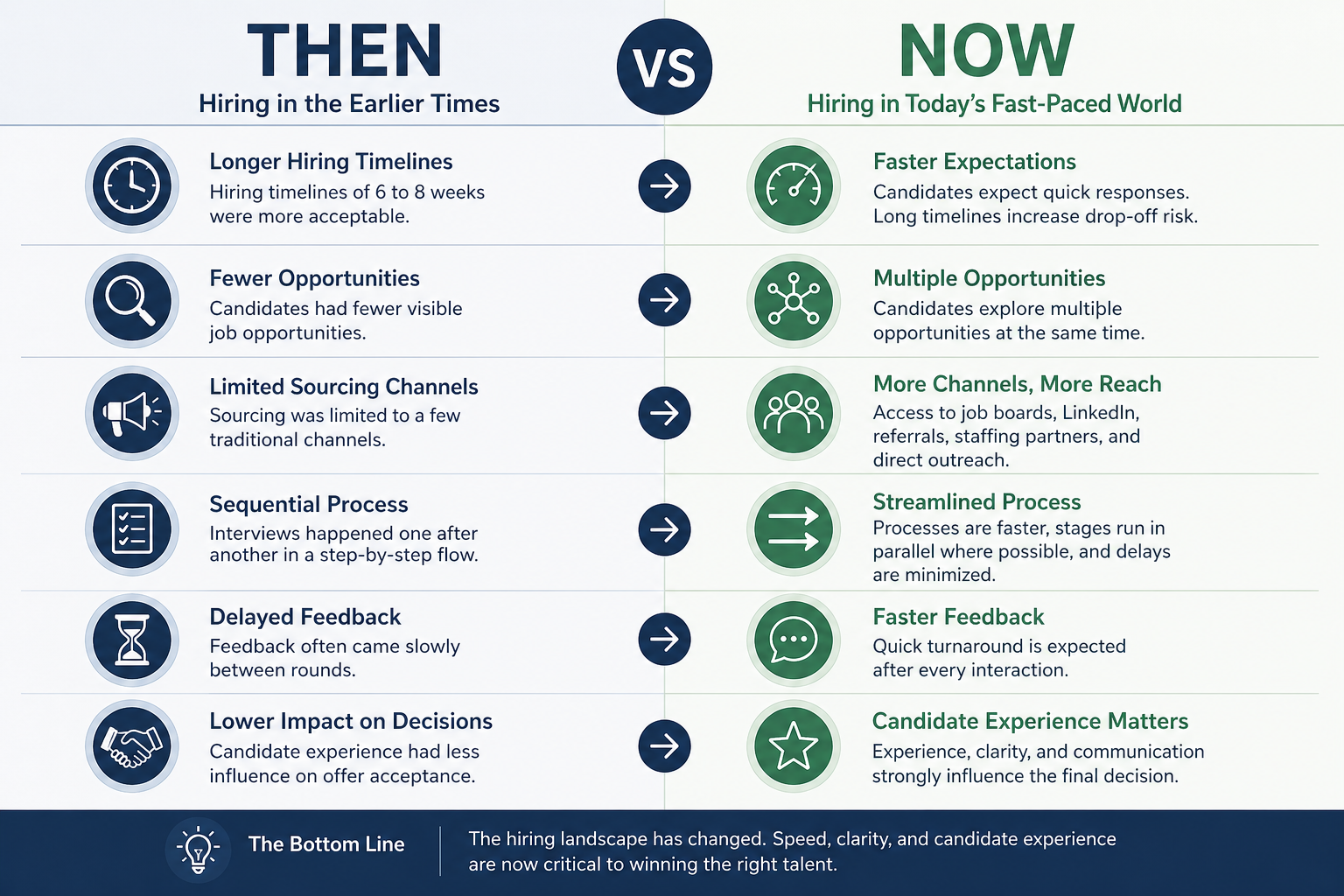
Delays are now often interpreted as weak internal processes.
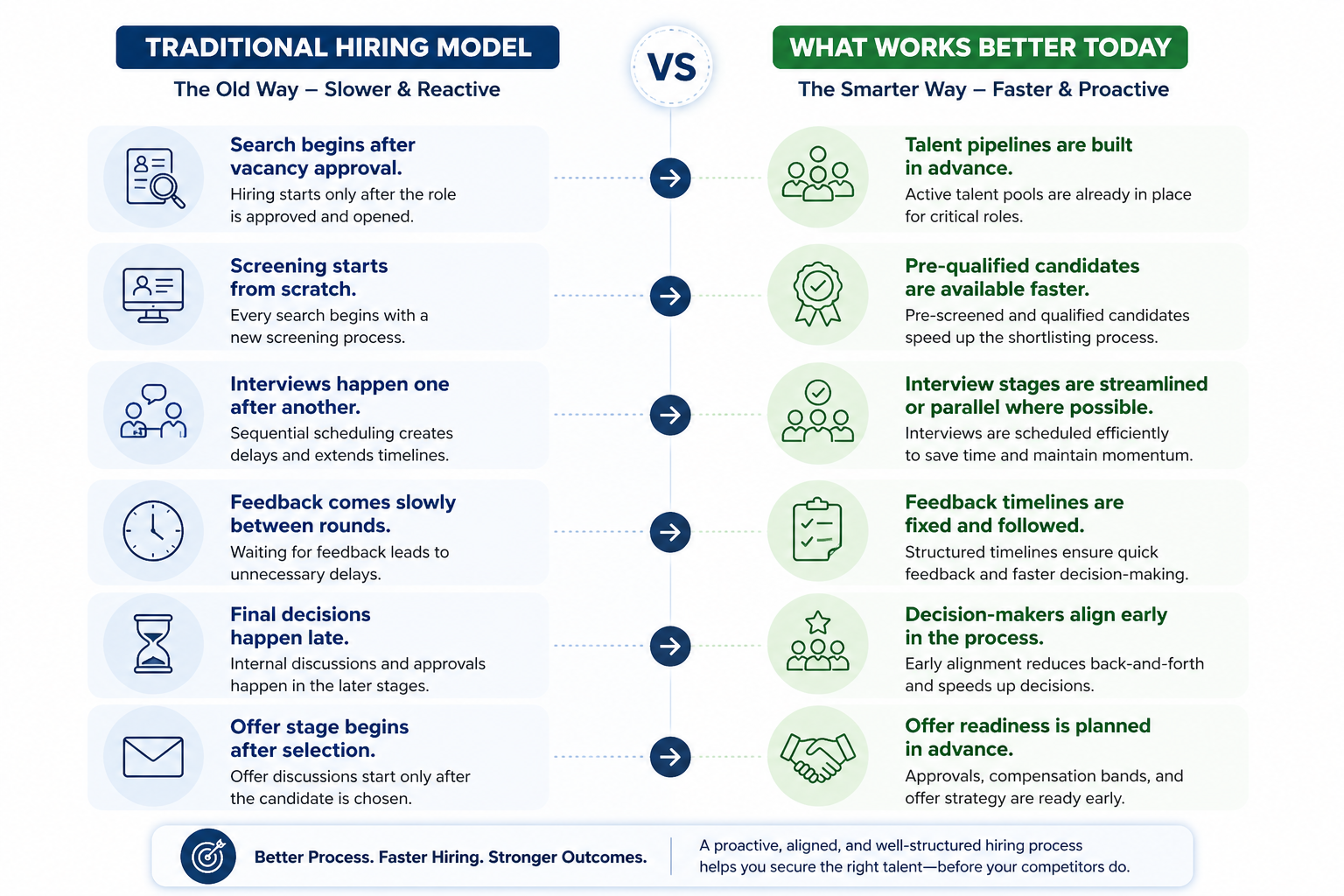
Many organizations still follow a hiring model that was built for a slower market.
The process often begins only after a vacancy is formally approved. Sourcing starts from scratch, screening follows, interviews happen one round at a time, feedback is collected in stages, internal discussions continue after final rounds, and only then does the offer process begin.
This linear model creates idle time between every step. A few days lost in sourcing, a few days in scheduling, a few days waiting for feedback, and a few more in approvals can quickly become weeks of delay.
A stronger hiring model works differently.
Talent pipelines are built in advance. Role requirements are clearly defined before the search begins. Screening moves faster because expectations are aligned early. Interview rounds are streamlined and scheduled quickly. Decision-makers are involved from the beginning rather than the end. Offers are prepared proactively so closure can happen without unnecessary delay.
That difference is not only about speed. It is also about being able to secure stronger talent before the market moves on.
The cost of slow hiring goes far beyond recruitment metrics. In many cases, the largest losses are felt elsewhere in the business.
Productivity cost: When open roles remain unfilled, existing employees take on additional responsibilities. This reduces focus, lowers efficiency, and increases burnout risk over time. Teams spend more energy covering gaps instead of progressing priorities.
Delivery cost: For project-based teams, delayed hiring can directly slow execution. Timelines shift, workloads rise, and client commitments become harder to manage when key roles remain vacant.
Revenue cost: In sales, account management, customer success, or other business-critical positions, every week of vacancy can affect growth opportunities. Missed outreach, delayed pipeline activity, and reduced coverage can create measurable commercial impact.
Candidate restart cost: When strong candidates drop out after weeks of interviews, companies often need to restart the process from the beginning. More sourcing, more screening, and more coordination follow, adding both time and cost.
Leadership time cost: Hiring managers, HR teams, and senior leaders spend repeated hours in interviews, internal discussions, approvals, and follow-up cycles. The longer the process runs, the more internal bandwidth it consumes.
That is why the cost of slow hiring is often underestimated. It impacts productivity, delivery, revenue, and management focus all at the same time.
Time-to-hire was once viewed mainly as a recruitment KPI used to measure hiring efficiency.
Today, it has a much wider impact.
It influences how quickly teams can scale, how fast projects can be delivered, how efficiently managers use their time, and how often companies secure high-quality talent. It can also shape employer perception, because candidates often judge a company by how clearly and professionally the hiring process is managed.
When two companies want the same candidate, hiring speed frequently becomes the deciding factor.
That is why time-to-hire should now be viewed as a business performance metric. It has a direct connection to growth, execution, competitiveness, and talent quality.
Improving time-to-hire does not require lowering hiring standards. It requires removing delays that add little value and improving process discipline.
Reduce unnecessary interview rounds: Every interview stage should have a clear purpose. If multiple rounds are evaluating the same areas, the process can be simplified without reducing quality.
Align decision-makers early: Hiring managers, recruiters, finance teams, and leadership should align early on urgency, compensation range, and must-have criteria. This avoids late-stage debates.
Set clear feedback timelines: Candidates should not be left waiting after interviews. Structured feedback timelines help maintain momentum and improve candidate experience.
Prepare offers in advance: Compensation bands, approvals, and sign-offs should be ready before final selection so the offer stage does not become a bottleneck.
Use external expertise where needed: Staffing partners can help with active talent pipelines, faster shortlisting, market intelligence, and continuous candidate engagement.
At ASK Consulting, we focus on building ready talent pools, delivering relevant shortlists quickly, coordinating interviews efficiently, and maintaining candidate engagement throughout the process. We also support clients with market insights around compensation expectations, candidate availability, and hiring trends.
This allows clients to make faster and better-informed hiring decisions while reducing the burden on internal teams.
The goal is not simply to fill roles faster. It is to reduce hiring friction, protect business momentum, and help clients secure the right talent before the market moves on.
Companies do not always lose candidates because they offer less. In many cases, they lose candidates because they move slower.
That is why the strongest hiring strategy is no longer just finding the right talent. It is being ready to hire that talent while they are still available.

Where we are